Epoch Batteries
48V 100Ah (5.12kWh) - Self-Heating Server Rack Lithium Battery
48V 100Ah (5.12kWh) - Self-Heating Server Rack Lithium Battery
Couldn't load pickup availability
Self-heating 3U server rack LiFePO4 battery
Epoch 48V 100Ah Server Rack Lithium Battery (5.12kWh) | Self-Heating
5.12kWh lithium battery storage in a compact 3U rack-mount chassis for home solar backup, off-grid power walls, and professional ESS builds.
The Epoch 48V 100Ah server rack battery is a self-heating 5.12kWh lithium battery built for DIY solar builders, off-grid homeowners, and professional installers. This Epoch 48V battery combines a compact 3U rack mount lithium battery chassis with CAN/RS485 communication, parallel expansion up to 32 batteries, 6,000+ cycle life, and active heating support for cold-climate energy storage.
Built for energy storage systems
Seamless Closed-Loop Inverter Communications
CAN/RS485 ports for smarter 48V home solar backup and off-grid power wall systems.
For technical buyers, inverter communication is often the deciding factor. The Epoch SR48100H includes CAN and RS485 communication ports so the BMS can share battery status, charge and discharge limits, and state-of-charge data with compatible inverter systems.
Epoch documents compatible inverters over CAN (Victron, SMA, Studer Innotec, Sofar, Sol-Ark, Solis, Goodwe, Deye, Growatt, SAJ, LuxPower, Megarevo, INVT, Sermatec, TBB, MUST, Sunsynk, and Schneider) and over RS485 (Voltronic, RCT, MPP Solar, Alpha-Outback, and Phocos). Set the protocol with DIP switches 6 and 7 on the master battery, use the matching inverter communication cable (Version I, II, or III, sold separately), and confirm the inverter firmware before commissioning. For other inverters, contact Epoch support.
Built for Cold Climates: Active Self-Heating Technology
A self-heating server rack battery for dry, protected garages, utility rooms, and battery rooms.
This Epoch battery uses incoming charge current to warm its cells before charging in cold conditions.
The heater starts when the battery is between -25°C and 5°C (-13°F to 41°F) and incoming charge current reaches 0.08C (8A), and it stops when the battery reaches 12°C (54°F); in a parallel bank, all batteries heat together. The cells themselves charge only from -10°C to 50°C (14°F to 122°F), with inverter communication, which gives the battery its -25°C to 50°C charge rating with heating. Little or no charge current during warm-up can be normal.
Massive Scalability: Build Your Ultimate Power Wall
Start with 5.12kWh. Scale your 48V battery bank as your loads grow.
One battery stores 5.12kWh nominal energy, making it an excellent building block for solar backup, emergency power, and off-grid ESS projects. When your power needs grow, the SR48100H supports plug-and-play parallel expansion.
Wire multiple batteries in parallel to grow from a single 5.12kWh starter system to larger banks. Epoch lists support for up to 32 batteries in parallel (3,200Ah, 163.84kWh), with automatic battery addressing, allowing large rack-based 48V storage systems when installed with proper communication, busbars, overcurrent protection, and qualified system design.
Enterprise-Grade Safety, Certifications & 11-Year Limited Warranty
Purpose-built for serious home energy storage and off-grid power systems.
Standard 3U Size & Rack Integration
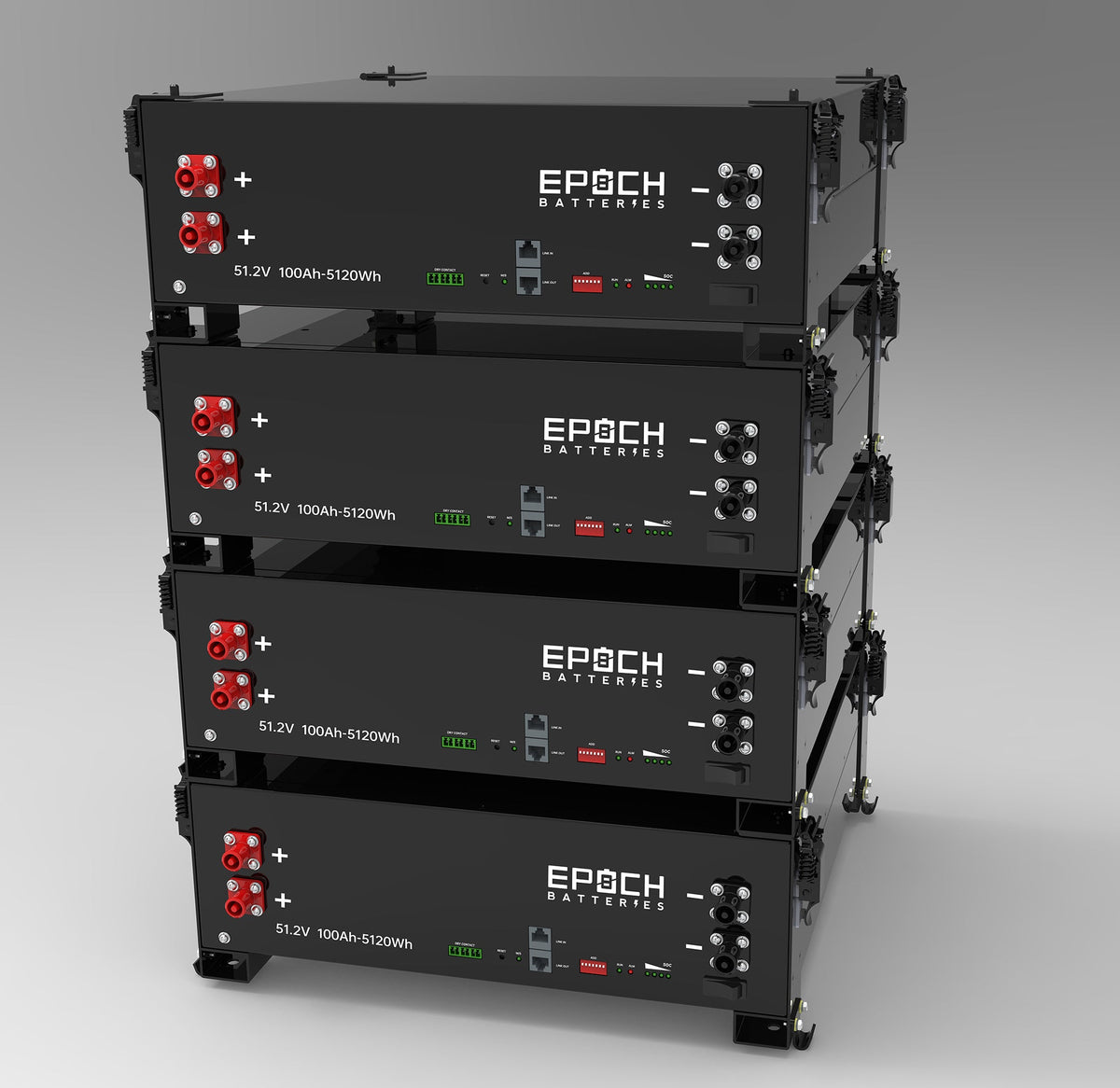
The 3U form factor is designed for standard 19-inch server racks, telecom racks, and solar battery cabinets. This keeps wire management clean, and the stack kit (sold separately) stacks up to four batteries vertically to save floor space. Wall and floor kits are also available.
Code Compliance & 6,000+ Cycle Life
The battery is listed to UL 1973 (ANSI/CAN/UL 1973:2018) at pack level through ETL, and UL 9540 certification is pending. Its BMS protects against overcharge, over-discharge, over-current, short circuit and reverse polarity, and high and low temperature, with a pre-charge circuit, and the cells are rated for 6,000+ cycles at 0.2C and 90% DoD (25°C, to 60% of initial capacity). Always confirm current certification documents with Epoch and the local authority having jurisdiction before permitting a grid-connected ESS.
Compatible applications
Home solar backup, off-grid power walls, and rack-mounted ESS builds.
- ✓ 48V home solar backup and residential energy storage systems.
- ✓ Off-grid solar battery banks for homes, cabins, shops, and remote power.
- ✓ DIY solar builders looking for a 3U rack mount lithium battery with CAN/RS485 communication.
- ✓ Professional installers building closed-loop inverter systems with Victron, Sol-Ark, Growatt, SMA, Deye, Schneider, Luxpower, or similar equipment.
- ✓ Dry, protected garages, utility rooms, and battery rooms where self-heating supports cold-weather charging.
- ✓ Expandable rack-based energy storage banks where batteries are paralleled as capacity grows.
- ✓ Protected 48V rack installations in RVs, motorhomes, and expedition vehicles.
- ✓ Ham radio and communications backup power.
- ✓ Wall, rack, floor, or stacked installations using approved accessory kits and qualified installation practices.
Battery features
Spec-driven details for serious 48V system builders.
Technical specifications
Rack dimensions, charge limits, inverter communication, parallel expansion, and operating conditions.
| General | |
|---|---|
| Brand | Epoch Batteries |
| Model / SKU | SR48100H |
| Battery type | 48V 100Ah self-heating LiFePO4 server rack battery |
| Rack format | 3U, standard 19-inch rack or cabinet |
| Chemistry | LiFePO4 / Lithium iron phosphate |
| Cell configuration | 16S1P |
| Installation types | 19-inch rack; stack (max 4), wall, or floor kits (not included) |
| Cycle life | 6,000+ cycles (0.2C, 90% DoD, 25°C, to 60% of initial capacity) |
| Warranty | 11-year limited warranty: free replacement in Years 1–3, then 40% off MSRP on a replacement battery in Years 4–11. Register within 90 days or keep your proof of purchase. |
| Voltage and capacity | |
| Nominal voltage | 51.2V |
| Nominal capacity | 100Ah (0.2C, 25°C) |
| Nominal energy | 5.12kWh (5,120Wh at 0.2C) |
| Usable energy | 4.92kWh at 0.2C (96% DoD) |
| Charge (absorption) voltage | 56.0V |
| Absorption end | Hold 56.0V until current falls to 0.02C (2A) |
| Float voltage | 54.6V |
| Re-charge / generator start voltage | 50.0V |
| Operating voltage range | 48.0V – 56.0V |
| End discharge / inverter cutoff | 48.0V |
| Restart voltage | 52.0V |
| Internal resistance | ≤30mΩ (1kHz AC, 50% SOC) |
| Current ratings | |
| Max continuous discharge | 100A (1C; starting temperature ≤30°C) |
| Recommended discharge current | 50A or less |
| Max continuous charge current | 70A |
| Recommended charge current | 50A or less |
| Peak discharge | 119A for up to 5 minutes; 200A for up to 15 seconds |
| Short-circuit protection | Yes — automatic load cut-off |
| Power cables and terminals | 125A maximum, 100A continuous suggested per cable and terminal |
| Communication and inverter compatibility | |
| Communication ports | CAN / RS485 (RJ45 Link IN / Link OUT); no Bluetooth |
| Closed-loop communication | The BMS shares state of charge, alarms, and charge and discharge limits with the inverter |
| Protocol setting | DIP switches 6–7 on the master battery; DIP 1 sets the RS485 baud rate |
| CAN inverters | Victron, SMA, Studer Innotec, Sofar, Sol-Ark, Solis, Goodwe, Deye, Growatt, SAJ, LuxPower, Megarevo, INVT, Sermatec, TBB, MUST, Sunsynk, Schneider |
| RS485 inverters | Voltronic, RCT, MPP Solar, Alpha-Outback, Phocos |
| Dry contact | Charge and discharge enable outputs; rapid-shutdown input (optional, U.S. market) |
| Parallel communication | Link OUT to the next battery’s Link IN; automatic addressing |
| Parallel expansion | |
| Series connections | Not supported — do not connect in series |
| Parallel connections | Max 32 batteries in parallel, plug and play |
| Example 4-battery bank | 400Ah, 20.48kWh nominal |
| Example 16-battery bank | 1,600Ah, 81.92kWh nominal |
| Example 32-battery bank | 3,200Ah, 163.84kWh nominal |
| Temperature and heating | |
| Charge temperature range | -25°C to 50°C (-13°F to 122°F), with heating |
| Cell charge temperature range | -10°C to 50°C (14°F to 122°F), with communication |
| Discharge temperature range | -20°C to 50°C (-4°F to 122°F), with communication |
| Heating start condition | Battery temperature -25°C to 5°C and incoming current ≥0.08C (8A) |
| Heating completion condition | Battery temperature ≥12°C (54°F); 1 hour later on the first full charge; a parallel bank stops when all batteries reach 12°C |
| Operating environment | Optimum 15°C to 35°C (59°F to 95°F); 5%–90% RH, non-condensing; below 3,000 m |
| Self-discharge rate | ≤3% per month / ≤15% per year (sleep or power-off mode) |
| Dimensions and weight | |
| Rack height | 3U / 5.2 in (133.5 mm) |
| Product dimensions (L × W × H) | 17.4 in × 18.1 in × 5.2 in (442 × 460 × 133.5 mm) |
| Size with ears and handles | 482.6 mm (19.0 in) wide across the rack ears; 510 mm (20.1 in) deep including the front handles |
| Weight | 101 lb (46 kg), without accessories |
| Case | Metal 3U chassis with front handles and rack ears |
| Terminals | Plug-in power connectors: 2 positive, 2 negative; grounding point on the front panel |
| Protection and compliance | |
| BMS protection | Overcharge, over-discharge, over-current, short circuit and reverse polarity, high and low temperature; pre-charge circuit |
| IP rating | IP20 per IEC 60529 — indoor use only |
| Certification | UL 1973 (ANSI/CAN/UL 1973:2018), ETL, pack level; UL 9540 pending — confirm current certification documents for permitting |
| Transport | UN 38.3; Class 9 lithium battery shipping classification |
| Storage | 15°C to 35°C (59°F to 95°F), 5%–75% RH recommended; up to 6 months at 0°C to 30°C, up to 3 months at -10°C to 45°C |
| Storage SOC | Near 50% for long-term storage (not above 80% for long periods); check every 3 months |
Closed-loop communication is strongly recommended
Let the BMS and inverter manage the system together.
The specification notes that communication between the battery and inverter is important to maximize dynamic performance and lifespan. Configure the correct protocol, communication cable, DIP settings, and charge/discharge limits before commissioning the system.
Fitment and installation note
Verify the complete system before installation.
Installation should be performed by qualified personnel. The battery weighs about 101 lb (46 kg), so lift it with two people, and never install it upside down or on its side. Confirm rack depth (510 mm / 20.1 in including the front handles), rack weight rating, ventilation, grounding, battery-to-battery communication wiring, inverter protocol, DC cable sizing, breaker/fuse sizing, torque, and local code requirements before installation. Always follow Epoch’s latest manual, inverter documentation, and local electrical code.
48V 100Ah Server Rack Battery FAQs
Common questions about inverter communication, self-heating, racks, parallel expansion, and permitting.
Which inverters does this battery communicate with?
The Epoch 48V 100Ah server rack battery communicates with compatible inverters through the master battery’s Link IN port, over CAN (Victron, SMA, Studer Innotec, Sofar, Sol-Ark, Solis, Goodwe, Deye, Growatt, SAJ, LuxPower, Megarevo, INVT, Sermatec, TBB, MUST, Sunsynk, and Schneider) and over RS485 (Voltronic, RCT, MPP Solar, Alpha-Outback, and Phocos). Set the protocol with DIP switches 6 and 7 on the master battery and use the matching inverter communication cable (Version I, II, or III, sold separately). For other inverters, contact Epoch support.
Can I install these batteries in my unheated garage?
Yes, when the space is dry and protected. The battery is rated to charge from -25°C to 50°C with heating: from -25°C to 5°C, with at least 0.08C (8A) of incoming charge current, the heater warms the cells until the battery reaches 12°C, and the cells charge only from -10°C to 50°C. It is an IP20 indoor-use battery, so install it in a dry, protected garage, utility room, battery room, or cabinet, away from rain, condensation, washdown, and salt air.
What is the continuous output of a single 48V 100Ah battery?
A single unit is rated for 100A maximum continuous discharge. At 51.2V nominal, that equals roughly 5,120 watts of DC output. For large inverters, well pumps, compressors, or high-surge tools, it is best to size the inverter and battery bank together and often use multiple batteries in parallel for extra surge headroom and lower stress per battery.
What does 3U mean, and what size rack do I need?
3U refers to the vertical rack height. One rack unit is 1.75 inches, so a 3U battery is about 5.25 inches tall. This battery is designed for standard 19-inch rack and cabinet systems, with listed dimensions of 17.4 inches by 18.1 inches by 5.2 inches. It is 482.6 mm (19.0 in) wide across its rack ears and 510 mm (20.1 in) deep including the front handles.
What certifications does this battery have?
The SR48100H is listed to UL 1973 (ANSI/CAN/UL 1973:2018) at pack level through ETL, and its UL 9540 certification is pending. It is also UN 38.3 tested for transport (Class 9). Home energy storage projects often need approval from the local authority having jurisdiction, utility, or fire marshal, so confirm current certification documents with Epoch and the authority having jurisdiction before permitting a grid-connected ESS. The ETL certificate is listed under Downloadable resources.
Can I wire these server rack batteries in series?
No. These are native 48V (51.2V nominal) batteries, and series connection is not supported. Series or parallel connections beyond this model’s limits are excluded from the warranty. Use the plug-and-play parallel configuration to increase amp-hours and kilowatt-hours.
How many batteries can I connect in parallel?
Up to 32 batteries in parallel (3,200Ah, 163.84kWh), with automatic battery addressing. Use matched SR48100H batteries of similar age, condition, and firmware, charged to the same state of charge, and design the bank with correct communication wiring (each Link OUT to the next battery’s Link IN), busbars, breakers, fusing, rack hardware, and inverter settings.
Is this battery waterproof?
No. This is an IP20 server rack battery intended for protected indoor use. It should be installed in a dry, clean, ventilated environment such as a utility room, rack cabinet, battery room, shop, or protected garage. It is not an IP67 outdoor battery and should not be exposed to rain, washdown, bilge water, or moisture.
What charger settings should I use?
Epoch’s recommended settings are 56.0V absorption (hold until current falls to 0.02C, 2A), 54.6V float, and 50.0V re-charge, with up to 70A maximum and 50A or less recommended charge current per battery, and equalization disabled. For inverter/charger systems, use closed-loop CAN or RS485 communication so the BMS sets the charge and discharge limits; without communication, program 56.0V absorption and 54.6V float. Set the inverter’s low-voltage cut-off to 48.0V (restart at 52.0V) and its low SOC cut-off to 4%.
Share